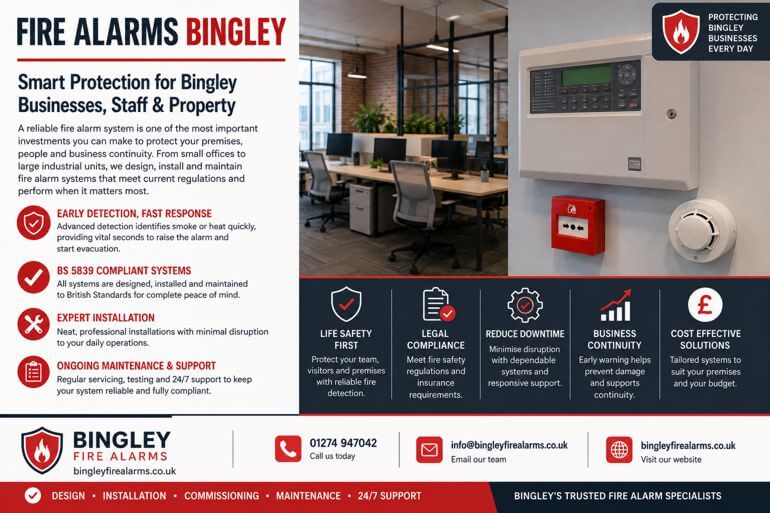
Office Refurb Fire Alarms –
Office layouts are constantly evolving. Across Bingley, businesses regularly reconfigure workspaces to accommodate additional staff, create meeting rooms, improve collaboration or support hybrid working. Whilst these changes often improve productivity, they can also have an unexpected impact on the effectiveness of a commercial fire alarm system.
Many business owners assume that because a fire alarm system was professionally installed several years ago, it will continue providing the same level of protection regardless of how the building changes. In reality, altering walls, ceilings, partitions or the use of individual rooms can significantly affect how quickly a fire is detected and how effectively occupants are alerted.
One of the most common changes seen in modern offices is the introduction of partition walls. Open-plan spaces are frequently divided into smaller offices, meeting rooms or quiet working areas. Although these alterations may appear relatively minor, they can affect smoke movement and potentially delay detection if automatic fire detectors are no longer positioned appropriately for the revised layout.
Ceiling alterations present another consideration. Many refurbishment projects involve suspended ceilings, acoustic panels, lighting upgrades or new ventilation systems. Each of these can influence detector positioning and coverage. A detector that was correctly located before refurbishment may no longer provide optimum protection once the ceiling arrangement has changed.
Meeting rooms have become increasingly important within commercial premises. Video conferencing, client presentations and collaborative working often result in spaces that are occupied for long periods with doors closed. Ensuring these rooms remain fully protected by the fire alarm system is an important part of maintaining life safety throughout the building.
Hybrid working has introduced further changes. Whilst fewer employees may be present on certain days, buildings often contain visitors, contractors and temporary staff unfamiliar with emergency procedures. A dependable fire alarm system ensures everyone within the premises receives a clear warning should an emergency occur, regardless of how frequently they use the building.
Reception areas should also be reviewed following refurbishment. These locations are often the first point of contact for visitors and delivery drivers and may be redesigned as businesses modernise their image. Fire alarm manual call points and sounders should remain clearly visible and accessible without becoming hidden behind new furniture, feature walls or decorative installations.
Plant rooms, comms rooms and electrical cupboards are frequently overlooked during office improvements. However, as businesses invest in additional IT infrastructure, these spaces often contain increasing amounts of electrical equipment. Reviewing automatic fire detection within these areas helps ensure developing faults can be identified as early as possible.
Another important consideration is future expansion. Many Bingley businesses carry out refurbishment work in stages, extending offices over several months or years. Designing fire alarm modifications with future growth in mind can reduce unnecessary disruption and avoid repeated alterations to the system as the business develops.
Professional fire alarm maintenance visits provide an ideal opportunity to identify these issues. Competent engineers not only test the operation of the system but can also recognise changes within the premises that may affect detector coverage, sounder performance or manual call point accessibility.
Fire risk assessments should also be reviewed whenever significant building alterations take place. The assessment should reflect how the building is currently occupied rather than relying on historic information from before the refurbishment. This helps ensure that the fire alarm system continues to support the overall fire safety strategy for the premises.
Employee awareness is equally important. If office layouts change, evacuation routes and assembly procedures may also change. Staff should understand any revised arrangements and know where manual call points are located within the updated workplace.
Modern commercial fire alarm systems are designed to be adaptable. Additional detectors, sounders and interfaces can often be incorporated into existing systems, allowing protection to evolve alongside the business without the need for complete replacement.
For businesses throughout Bingley, office refurbishments represent an investment in future growth. Reviewing the fire alarm system at the same time ensures life safety keeps pace with operational improvements. It is a practical, proactive step that helps protect employees, visitors and business continuity while maintaining confidence that the system will perform exactly as intended should it ever be needed.