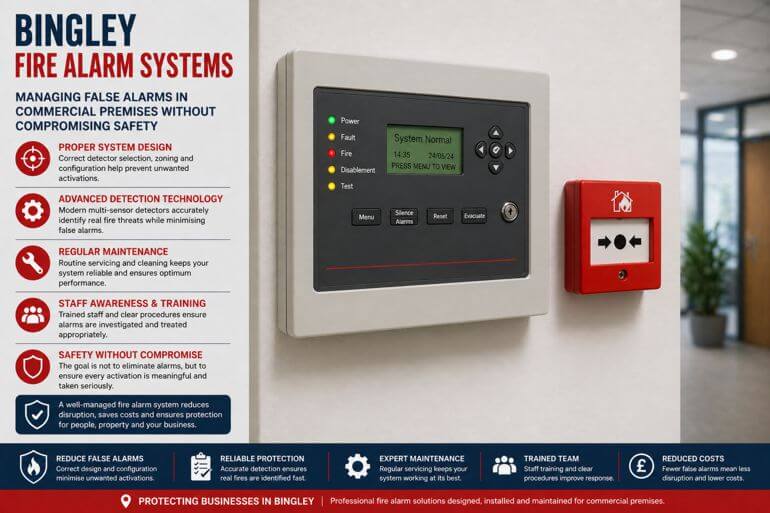
Bingley Fire Alarm Systems Reduce False Alarms –
For businesses in Bingley, fire alarm systems are essential for protecting people, property and continuity of operations. However, one of the most common issues faced in commercial environments is the occurrence of false alarms. While often seen as a nuisance, false activations can have serious implications, including disruption, complacency and unnecessary emergency responses. The key is not to reduce sensitivity, but to manage false alarms properly without compromising life safety.
False alarms typically occur due to environmental factors rather than system faults. Dust, steam, cooking fumes and even aerosols can trigger detectors if the system is not correctly specified. In Bingley commercial premises such as offices, kitchens, workshops and retail units, different areas present different conditions — and therefore require different types of detection.
This is where system design becomes critical. A well-designed fire alarm system will use the correct detector type in each environment. For example, optical smoke detectors may be suitable for office spaces, while heat detectors are more appropriate for kitchens or areas where smoke or steam is regularly present. Using the wrong detector type is one of the leading causes of false alarms.
Zoning also plays an important role. By dividing a building into clearly defined zones, the system can identify exactly where an alarm has been triggered. This allows staff to investigate quickly and determine whether the activation is genuine. In larger Bingley premises, zoning significantly improves response and reduces unnecessary disruption.
Modern fire alarm systems offer advanced detection technology that helps reduce false activations. Multi-sensor detectors, for example, combine different sensing methods to better distinguish between real fire conditions and environmental factors. This provides a more accurate response without reducing sensitivity.
System configuration is equally important. Sensitivity levels, time delays and confirmation settings must be carefully adjusted to suit the environment. Poor configuration can either lead to excessive false alarms or, worse, delayed response to real incidents.
User interaction is another key factor. In many cases, false alarms occur due to accidental activation of manual call points or lack of awareness around system operation. Staff in Bingley businesses should be trained to understand how the system works and how to respond appropriately.
Maintenance is essential in preventing false alarms. Over time, detectors can become contaminated with dust or debris, affecting their performance. Regular servicing ensures that all components are clean, calibrated and functioning correctly.
Environmental changes within a building can also impact system performance. Layout changes, new equipment or changes in use can all introduce new factors that affect detection. Regular reviews ensure that the system remains suitable for the current environment.
False alarms should always be investigated, not ignored. Repeated activations in the same area often indicate an underlying issue that needs to be addressed. Identifying and resolving these issues improves overall system reliability.
Despite the inconvenience they may cause, fire alarm systems must never be compromised to reduce false alarms. Disabling detectors, lowering sensitivity excessively or ignoring activations creates significant risk and may lead to non-compliance.
Integration with other fire safety measures is also important. Fire alarms should work alongside evacuation procedures, emergency lighting and staff training to ensure a coordinated response.
Documentation plays a role in managing false alarms. Keeping records of activations, investigations and maintenance helps identify patterns and supports ongoing improvement.
For businesses in Bingley, the goal is not to eliminate alarms, but to ensure that every activation is meaningful and taken seriously. By focusing on correct system design, appropriate detector selection and regular maintenance, false alarms can be significantly reduced without compromising safety.
Ultimately, a well-managed fire alarm system provides both protection and confidence. It ensures that when an alarm sounds, it is treated with the urgency it deserves — protecting people, property and business operations.